
Imagine the following scenario: a woman who suffers physical or psychological violence musters courage and decides to seek help. She opens her cell phone and types into Google Maps "Delegacia da Mulher," copies the address, and goes to the place. Upon arriving there, she finds an abandoned house, falling to pieces and used by drug users.
That symbolic scene became reality in Curitiba starting in 2017, when the building of the former Delegacia da Mulher, located at Rua Padre Antônio, 33, was shut down. The services that had been available in that space began to be offered elsewhere, at the Casa da Mulher, which is in the Cabral neighborhood. However, the address of the former police station remained on official channels and online.
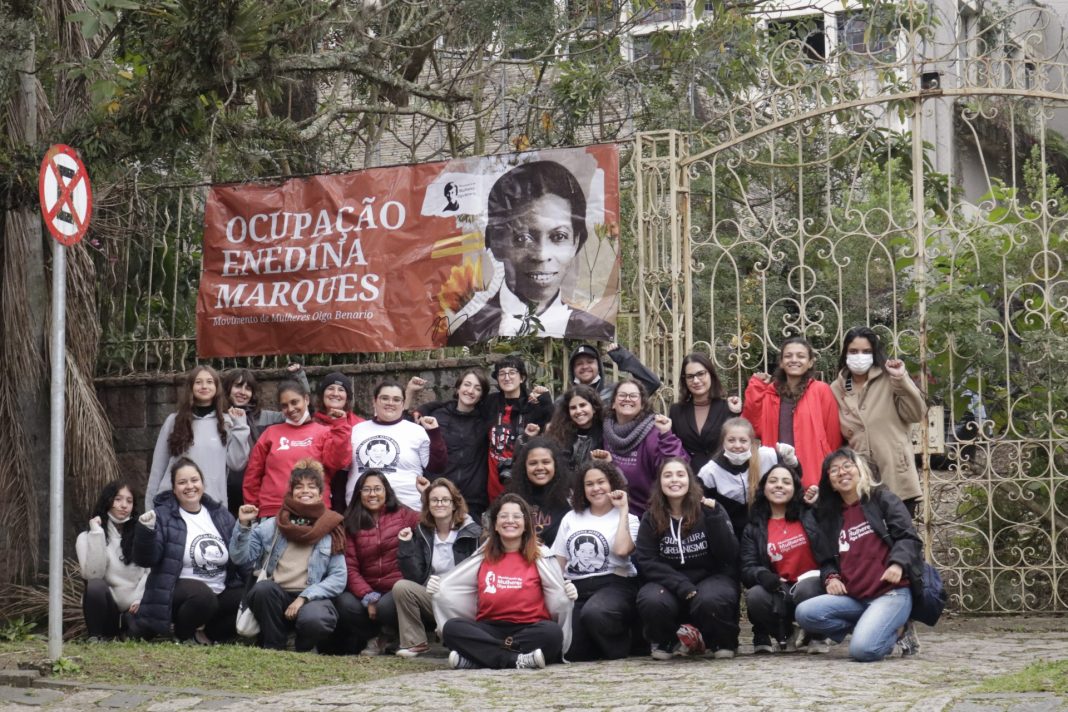
In 2025, after eight years of the property being abandoned, a women’s collective chose to change that. The Olga Benário Movement occupied that space on the International Day of Black, Latina, and Caribbean Women, July 25. The occupation transformed the place, which is next to the Colégio Estadual do Paraná, into Casa Enedina Marques, a 24-hour reference house for women.
Gabriela Torres, an activist with the Olga Benário Movement, sums up the activities of the place: “A reference house is a place where a woman goes to receive care and support from a professional in the area she needs, whether a social worker, psychologist, or lawyer.”
The National Survey on Violence Against Women, conducted by DataSenado, shows in its 10th edition that 35% of women in Paraná have already experienced some type of domestic or family violence perpetrated by a man. Since the start of activities at Casa Enedina Marques in July 2025, 78 women have already sought help and were welcomed at the occupation. In two years of activity in Curitiba, the Olga Benário Movement has already welcomed more than 180 women.
The professionals who work at Casa Enedina Marques are volunteer social workers, psychologists, and lawyers who support the cause. To ensure 24-hour service, the activists organize in shifts, in case women seek support in situations of abuse or violence.
For the safety of the women served, the occupation does not function as a shelter — a place where women whose physical integrity is at risk can stay. When that is the case, the volunteers refer the situation to the organization “Beleza Escondida,” which works to protect women and their children through protective homes, insertion into the world of work, social and psychological support, among other activities.
Torres states that Casa Enedina Marques has strong dialogue with institutions such as Casa da Mulher Brasileira, CRAS, and CREAS. The organization does not receive government support and depends on donations, contributions, and mainly on the sale of clothing at the bazaar that operates on site. The bazaar is open every day, but the heaviest traffic is on Saturdays and Sundays.
“A large portion of the women, in fact, come for the bazaar, come because there is the cake-in-a-jar workshop, a course on Marxism, and only later begin to understand that they are in a situation of violence,” says Torres.
In addition to the bazaar, the house promotes various workshops and trainings, such as the printmaking workshop that took place in November 2025, and dance and capoeira classes, which are frequent. Activities are publicized on the house’s Instagram account (@casaenedinamarques.)
How to ask for help?
In an emergency, when immediate intervention is needed, call 190. In cases of violence against girls and women that do not require immediate intervention, dial 180.
The Casa da Mulher Brasileira in Curitiba has reception and a Delegacia da Mulher operating 24 hours a day. The address is Avenida Paraná, No. 870 – Cabral neighborhood. Phones: (41) 3221-2701 and (41) 3221-2710.
There are civil society organizations, such as Casa Enedina Marques, that offer support, access to health professionals specialized in gender-based violence, and access to therapists who work free of charge.
The Mapa do Acolhimento offers direct support to women survivors of violence, connecting them with a national network of volunteer psychologists and lawyers. There are volunteers in every state in Brazil.


